Sunday, April 11, 2010
The Pacific and Fan Generated Content
Tuesday, April 6, 2010
Student Gets Expelled Over Status Update on Facebook

What Not to Post
A teen from Brevard County Florida recently got expelled from school after his principal read his status update on Facebook. Apparently the student ranted about how much he hated his school and raved about how he was going to slit the principal’s throat and laugh while she bled to death. He also stated that he was going to tie all of the teachers up and set them on fire.

Where Should We Draw the Line?
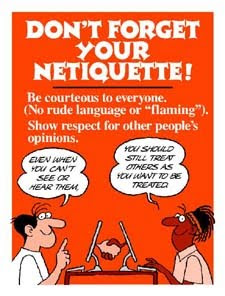
Okay, so we’ve all vented on Facebook before. I’ll be the first to admit that I was having a bad day yesterday and cursed the summer heat. But to curse at someone and threaten his or her life is out of line and should not be tolerated on Facebook or any other social networking sites. I know that you guys (my classmates) may be a little tired of me posting about etiquette when online, but I think that it should continue to be discussed because time and time again teens and adults alike fail to use common sense when posting.
The Virtual Takeover
Kim Yoo-chul and Choi Mi-sun were good parents. They dedicated hours on end to raising their daughter, Anima, while their real, unnamed, three-month old daughter starved to death.
This, and other recent issues regarding online addiction and cyber bullying, go beyond being irresponsible to reveal the tragedies that can happen when the virtual and real worlds collide. Nowhere is the potential for this greater than in the gaming and virtual world environments where some people spend as much as ten hours per day, not just playing games but living in pseudo worlds.
The fact is that most people responsibly manage their online and real world selves, and escaping to a virtual world is no more addictive than watching a good TV show. However, for some reason or reasons, others can’t get enough, which is unfortunate since virtual gaming is going to take over our lives according to Jesse Schell, a game designer and professor at Carnegie Melon University.
If the opportunities available in Second Life are any indication, Schell’s prediction has already started to unfold. The following is a sampling of the real life areas in which Second Life has already gained significant reach.
Entertainment
Video games, and by extension, online games used to be for kids. Statistics show however, that the vast majority of virtual players are adults older than 26. With so many environments to choose from: outlandish planets with their own culture to the ability to create one’s own alter-environment, it is no wonder that the more popular sites like Second Life play second home to more than two-million subscribers with more than 50,000 online at a given time.
Commerce
As if the sheer entertainment value isn’t staggering enough, virtual environments are giving a deeper meaning to the term e-commerce. Virtual shops and businesses that were once figments of someone’s imagination are translating into real dollars for some people. But how? Forbes has a list of virtual professions that have turned out to be pretty lucrative.
Already established, social media savvy companies, like Dell, are also getting in on the act.
Education & Training
Second Life actively promotes its platform as a medium for education and training. The advantages for learning institutions and businesses lies in the fact that Second Life goes beyond the typical tools used for teleconferencing and distance learning. In addition to the ability to meet online for collaboration purposes, real environments such as the classroom can be mimicked, and simulations can be created without having to develop new software technology.
Despite these advantages, some colleges are returning to the real world in hopes of creating their own virtual environments following Second Life experiences that did not live up to the hype. Considering its commercial success, Second Life might be a better alternative for companies like Alpine Access that are in need of an interactive meeting point for employees that are geographically dispersed across the country.
While it is my personal hope that gaming technology does not grow to the point (at least not in my lifetime) where it is somehow integrated into how we brush our teeth, as Schell asserts, where we are at now is clearly only the beginning.
Monday, April 5, 2010
Risky Recruiting with Social Media
Of course, the hiring authority at XYZ would be equally foolish not to check me out on every available network. In fact, one could argue—if not yet, then soon—that the company who didn’t scour the Internet for every tidbit about a potential new hire was being negligent.
It’s too soon to tell, but this scenario has been suggested as one of the real threats social media has introduced into human resources and the employment life cycle. Another possibly more serious threat is the charge of discriminatory hiring practices, stemming from the use of information that employers find on social media networks—information that would not/should not have come out during a typical interview. Ethical hiring managers are careful to avoid asking interview questions about religion, sexual orientation and the like; but what is the correct response when they find pictures or texts of such privileged information on a networking site?
On paper, that answer is easy: ignore the contraband and continue evaluating the candidate for all the right (i.e., job-related) reasons. In reality, however, those cards have already been played, and you can bet that even the most conscientious among us would find some job-related insufficiency to weed out candidates that didn’t meet our surreptitious criteria. Assuming that we were able to rise above such behavior, proving that we did so would present an exceptional challenge.
Renee Jackson, an associate with the law firm of Nixon Peabody, wrote about these risks in a January article for the National Law Journal. She warned that “employers must address their use and misuse [of social media] before, during and after an employee’s tenure.” She confirms that employers may face liability for using information learned about a candidate from a social media site. Protected class status—race, age, disability, religion, etc.—are off limits and cannot be considered in hiring decisions. She echoed what I’ve read in other places: that it would be hard for an employer to prove that it viewed, but did not use, the information from a social network.
Jackson also lists some information employers can lawfully use in their decision-making. Illegal drug use, poor work ethic, poor writing or communication skills, feelings about previous employers and racist or other discriminatory tendencies that may be revealed online are fair game. And, in a tongue-in-cheek warning to applicants, she reminds us that employers may “lawfully consider an applicant’s general poor judgment in maintenance of his or her public online persona.”
As social media permeates the workplace, greater access to information brings opportunities and risks for employers and employees. Essentially, both parties have to be alert and weigh the benefits against the risks of using social media-both on and off the job.
Meow, Meow, Myspace! Social Media and Pets

Social Media has changed how we interact with our pets and others
As I write this blog, my "child" is sitting on my shoulder, serving as both muse and distraction. This "child" is not, in fact, human; it is my one year old cat who plays quite a large role in my life. When he is not removing keys from the laptop or snoring on the couch, Soscal, my cat, enjoys staring into the screen because it is bright and it moves. These two traits are major prerequisites for holding a feline's attention. However, some pet owners have taken this interest to a novel level with the creation of social media profiles for pets of all kinds.
A Place to Call Their Own
Time recently reported that pet owners have banded together to create a version of Facebook entitled Doggyspace andMycatspace . These websites feature pet profiles that allow the owner to post pictures, create status updates, and befriend similar breeds. Instead of focusing on the human, these sites are supposed to be from the pet's perspective. Doggyspace claims that it "is a social utility that connects people with friends and others who love dogs. People use Doggyspace to keep up with friends, upload funny dog videos, and to give their dogs their own cyber place." The site, along with Mycatspace, features blogs, headline pet news, and forums to discuss the joys and trials of pet parenting. Doggyspace also allows users to search by breed in order to find other Great Dane devotees or German Shepherd groupies.
Making it Accessible
The Iphone and Ipod Touch now feature a Doggyspace app. Users can easily access information about their pet's "friends" while on the go. Videos and groups encourage member participation while the unique pet focused forums could save hours of pet training or veterinary care if users band together to compile knowledge about a specific breed. Mycatspace is not quite as informative; though blogs, forums, and pictures do exist on the site, the main purpose seems to be entertainment value. There are several games that members can play as well as cutesy pictures for desktop backgrounds and screen savers. Only members can access the main parts of the site which does not lend itself to visitor stops.
Making Anonymity Easier
Blossom states in his book Content Nation that one of social media's biggest goals is to entertain. While this goal is most certainly the end result of the pet sites, they can also serve a very practical purpose. Users of social media who are not comfortable with sharing their name, city, or workplace can still find a way to express themselves online through pet profiles. By personifying your pet, you are allowing other users glimpses into your daily life and your personality. It gives pet owners the interaction that they may need with people of similar interests, but also allows the user to take the emphasis away from their own body or careers. Time also claims that "pets write messages to one another about shared interests and offer advice on health problems, training or local dog-friendly parks. Some have even enlisted their caretakers to arrange offline play dates." The user can extol Fido or Sassy's latest accomplishment for an audience of interested peers. What better way to use social media then for enjoyment?
A Few Problems
With more than 700,000 users of Doggyspace, social media for cats and dogs has really taken off. However, what about gerbils, snakes, bunnies and assorted other pets that do not fit into the traditional American home? Some bunnies have sneaked on to Doggyspace with the explanation that a Bunnyspace does not yet exist. So, unless your the owner of a dog and cat, you may have a hard time finding the social media site for you. Also, the dogs on Doggyspace tend to rack up friends even faster than their human counterparts. For this reason, it is imperative to keep personal information from infiltrating the site as it distributed to people you do not know except through the websi
te. Caution would have to play a role in using the sites.Soscal the cat
Overall, pet social media seems to be taking off at an advantageous time. People and their pets have gotten closer than ever and it no longer seems odd to create a profile for your furry friend. In fact, it may just allow me to figure out how to stop my cat from scratching my couch or how to appropriately keep him tick free. And all of this may mean a happier kitty, which means a less mutilated keyboard. I give it a two paws way up.
Utilizing Social Media: College Couture

My younger sister, Lydia, has recently started her own blog in March.
Titled "College Couture" it provides fun and fashion for college girls on a budget.
In an interview, Lydia states "I have always had a passion for fashion. I looked to fashion magazines and runway shows for advice on upcoming trends. However, I was really sick of going through magazines and finding none of their items really affordable. With the state of the economy and the recession, none of these items were really affordable for the average consumer. As a college student, I could not afford their items. How could I be trendy and chic without having to break the bank? I knew if I asked myself this question than others did too. And so my blog was born. Most of my items are under $30. I want to show other girls that you can still be trendy without having to pay high prices. I wanted consumers to know that they could still get a high fashion look without the high price. With my love for fashion and love for computers, I knew a blog was a good path to go on. I wanted everything to be online, so I could be environmentally friendly and not use paper. My future goal would be to eventually build my own website and I have already started on this project. I would also love to start a website for guys too."
I must say that I think my sister was very creative to come up with this idea for a blog. I didn't even communicate with her that I was in a social media class, so she came up with this idea on her own.
I think that people who have an idea for a business or a blog should definitely utilize social media to promote themselves, which my sister has brilliantly done. I wish her the best!
How to Be a Social Media “Guru”
Through some twist of fate, I recently found myself managing the social media of three clients, including two extremely well-funded startups. But I still have trouble answering the question, “So what exactly is it that you do, Jennifer?”
The other day, I told an author that being a social media guru was “easy.” Keeping me real, she replied, “Yeah, duh. It’s easy for you because you’re good at it. You’ve practiced and you know what you’re doing.”
And she was right. To some of you, math – which terrifies me – or swimming or cooking or piloting planes, might be the easiest thing in the world. That’s because you took the time to learn the rules and figure out what you’re doing. And that, in a nutshell, is how to be a social media guru, right?
…Okay, so maybe there’s a little more to it.
Do you really want to be a “Guru”?

First, I don’t really buy into the term “guru,” even though, sadly, it seems to have become the default term for the services I and my counterparts at this relatively new position provide. A traditional guru imparts words of wisdom to followers. But a social media expert should always, always start and maintain conversations. If all I did was drop a “Confucius says” quote on Twitter once and awhile, I wouldn’t be a very good social media guru, now would I?
When writing for social media, make sure to be as open as honest as possible. Sometimes that simply means asking questions that don’t have “Yes” or “No” answers. For example, which is the better Tweet?
"Do you think Company X should create an iPhone app?”
Or
"We here at Company X want your help designing our iPhone app! What features can you not live without?”
Of course #2 is the better Tweet, because it encourages participation and discussion. A “guru,” on the other hand, might simply announce “Company X is developing an iPhone app. So be it.” That’s not very social media like, is it?
Know Your Social Media Sites
The second ground rule in social media is to find ways to quickly ascertain the etiquette of any social media site you encounter. You should, of course, know the etiquette of the big sites like Twitter, Facebook and Linked in, but there are plenty of social media “sites” out there – blogs, forums, Nings, etc. – that don’t start with the letters T, F, and LI. You may have a real estate client who wants you to establish her presence on CitySearch.com, for example. Or you may have a client who wants you to establish her presence, but isn’t sure where. It’s your job to use the tools are your disposal, such as Alexa or Google PageRank to determine whether sites are big and bad enough for you to invest your time on.
Know Your Target Audience
On the other hand, you also have to be able to ascertain a social media site’s audience and decide whether that audience gels with the folks you’re trying to reach. Say you’re selling sausages. Don’t you think you would have a better chance of selling lots of sausages on the Sausage Lovers Forum (for god’s sake, never, ever Google that) with 3,000 members than you would on a bigger site like Facebook, where users may or may not be sausage lovers? Often, it pays in social media to hit a variety of targets both small and large. Read here for more on identifying your target audience.
Be Able to Show Return on Investment (ROI)
One of the biggest complaints about social media is that its ROI is hard to ascertain. That’s certainly the case. Just like with something like public relations or marketing, it can be difficult to discover whether your new customer randomly stumbled on your service or whether they did so because of a marketing, PR or social media effort on your part.
While there is no exact science when it comes to social media ROI, there are tools you can use to at least prove that your message is getting out there. First, you know you’re doing something right if you get more social media “followers” or “fans” on sites like Facebook or Twitter.
You also need to get analytical with tools like Google Analytics. This handy free tool tells you how many people are looking at your anchor website, what sources they are clicking in from (I.e. Twitter, Facebook, the Sausage Lovers Forum, etc.) and what they do (i.e. buy a product, subscribe to your mailing list, etc.) once they are on your site.
One caveat: Google Analytics and tools like it are not a foolproof way to discover the ROI you are generating from social media. A Twitter follower could love your Tweets and feel great affection to your company, but you would never know that that unexpected sale that just came through came from that guy because he simply typed in your website URL. In that way, social media is like public relations in that it generates general good feelings, but those feelings may not be quantifiable.
In Conclusion…
This is just a tiny encapsulation of what it takes to be a social media guru. As John Blossom has already illustrated, “everything” it takes would fill a book (or, more likely, a blog.) The most exciting – and nerve wracking – thing about the social media “guru” position is that it’s changing every day. There are a plethora of new sites, iPhone apps, strategies, analytic measures, laws and regulation to keep up with, and they are always changing. Social media is like the Wild West of the internet. Do you think you can strike your fortune?